

Take a seat and get comfortable, my high-flying friend. It’s time to talk about, well, taking a seat and getting comfortable. Are you one of those pilots who does a nail-biting amount of tugging and shimmying on the way into fully seated flight mode? Then this guide to paraglider harness fitting and 5 tips for paragliding comfort is for you.
After all, some day a thermal is going to fold up your canopy while you’re wiggling helplessly under your wing (probably, with your unheld brakes sitting nervously against the pulleys). A properly-fitted harness will, in all likelihood, solve the problem and lead to better paragliding experiences.
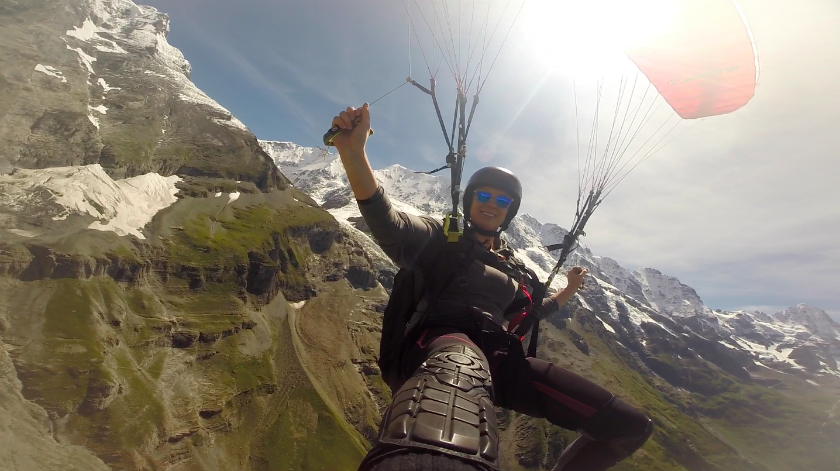
You pay a fortune for paragliding courses and gear, so getting the right fitting harness and setting it up properly should be a no brainer. And, as a bonus, it’ll make you a better, more confident pilot.
Guide to paraglider harness fitting
Buy smart. Don’t fall head-over-wallet for the sexiest new paragliding harness on the shelf. When you buy a harness, make sure of few things:
- The seat board should be just wide enough that, during a hard weight-shift, there is minimal width between the thigh and the uphill side of the harness.
- When you’re sitting all the way back in the harness, the seat board length should be approximately two fingers from the bend in your knee. Check for an extension to the front of the seat, the angle of which can be adjusted with a strap located on the forward part of either side.
- The back of the harness should be short enough that it doesn’t whack you in the back of the head. It should also be long enough that it adequately supports your upper back.
- The harness’s shoulder straps should be reasonably snug, without a lot of play in the system.
5 tips for paragliding comfort
Once you have a model that fits these criteria, it’s time for a more official paraglider harness fitting session. Hang it up in a simulator and manipulate the various settings. Here are your my top tips for paragliding comfort:

Build your ‘bucket’
A harness will generally have side lateral straps that adjust the angle described by the back rest and the seat board. Maladjusted, this strap can ‘open up’ the angle of the seatboard in a way that tends to dump the pilot against his/her chest strap. To prevent this from happening, lengthen the strap. The back of the seat will lower and create a ‘bucket’.
Take your time
According to USHPA Paragliding Instructor of the Year, Chris Grantham, you’ll need to be patient. ‘The pilot’s recline angle should be such that it doesn’t require stomach or neck muscles to keep your head upright’, Grantham explains. ‘But not so upright that you feel like you’re falling out the front. It takes usually take a few tries to find it, so be patient.’
Check for adjustment strap
Check for an extra adjustment point that might be messing with your setup. Some harnesses on the market include an adjustment strap that sits inside the rear of the harness. This setting adjusts the length of the backrest and, if it’s set too tight, will have the same dumping-out effect as a maladjusted lateral strap. Check to see if this is true for yours.
Don’t set yourself up for failure
One of the top tips for paragliding comfort is not to set yourself up for failure. You can do so by wearing bulky winter gear without accommodating the settings to the extra fabric. You can also do so by shoving gear into the back of your seat, or by using your seat ‘bucket’ as storage space.
Don’t forget the launch
The goal of your paraglider harness fitting session is to land on a configuration that delivers two things: comfort in flight and confidence on launch. Make sure that your settings allow you to roll easily back into the seat, so you’re not struggling to sit when you should be flying.
Fitting a paraglider harness is an art
‘Paraglider harness fitting is an art, really’, Chris Grantham concludes. ‘Even with all of the settings dialed in to perfection, it has to look right, which is, of course, hard to describe. Spend an hour on the ground perfecting your harness to your body and your comfort preferences, and the investment will come back to you in spades in the air.’
We hope these tips for paragliding comfort and guide to fitting help you to spend more time comfortably flying. Perhaps book one of these paragliding holidays worldwide to test this to the max!


