

John Lennon once said that there were two types of people in the world: those who take showers and those who take baths. It’s pretty obvious that between writing songs and having a nice lie in with Yoko, John never learnt to scuba dive. But if he had, he’d have read this BSAC vs PADI article comparing the different scuba qualifications first.

If he had, he would know that the real line drawn down the centre of humanity is between those who favour the Professional Association of Diving Instructors (PADI) and those who side with the British Sub-Aqua Club (BSAC) qualifications.
Just a quick search of the net and you can find literally hundreds of forums and threads discussing BSCA vs PADI. They all follow a similar pattern too. It starts off with an innocent question by someone keen to get in to diving. Namely, which certification should I do? What follows almost always descends into childish name-calling, boasting and one-upmanship.
So, in the interest of impartiality, here is a fair and reasoned look at them both, weighing up the pros and cons of each.
BSAC vs PADI: Cost of scuba diving
Simultaneously the most important and least important factor in diving. However, the two qualifications vary significantly. A basic PADI course preparing you for open water diving will set you back about £250. Ideal for beginners, this will cover all the prep work so that when you go away, you’ll be ready to try open water diving. However, a complete PADI Open Water course with the four open water dives required to qualify costs about £450.
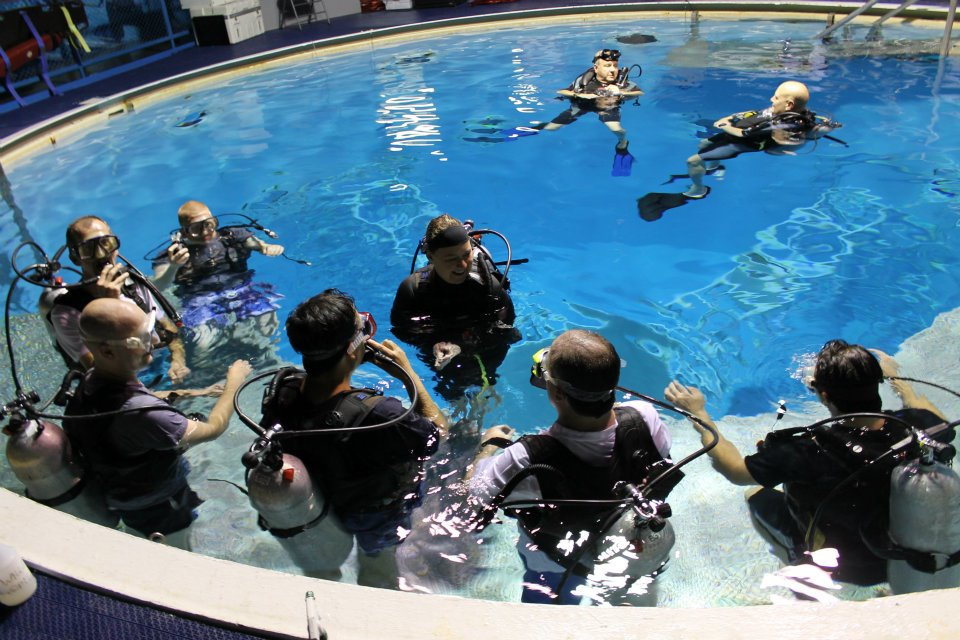
Comparatively, a BSAC course will be significantly less, as they are run by established diving clubs staffed and taught by volunteers. Because it’s a club network, they have access to plenty of facilities and dive sites. The Ocean Diver qualification (the equivalent to PADI Open Water) costs about £250 including one years membership of BSAC and this includes at least 5 open water dives. However, you also have to pay membership fees for your local club (which vary) and you might have to provide some of your own equipment.
The cost of diving once qualified varies greatly around the world but typically you will be charged the same with PADI or BSAC. However if you are regularly going to scuba dive in the United Kingdom once your are a BSAC member (£55 a year) it costs around £15 per dive so it is a lot cheaper. Round 1 goes to BSAC by a country fathom for being significantly cheaper.
BSAC 1 PADI 0
BSAC vs PADI: Reputation
As we’ve mentioned, the two don’t always see eye to eye. BSAC and its supporters see themselves as the pure guardians of diving an official body that likes to do things the safe and proper way. PADI is the swish newcomer that’s only in it for the money (apparently).
PADI view themselves as the professionals, providing quality instruction and widely recognised certification, believing the BSAC to be little more than well meaning amateurs. It is the most popular diving qualification worldwide and in many parts of the world it is the only qualification offered.
Both are generally very well respected both at home and abroad but PADI is the more popular and recognised in more countries. So if you want to dive in Thailand, Egypt or anywhere else, PADI is a little better – so it wins this round by a prawns whisker.
BSAC 1 PADI 1
BSAC vs PADI: Course content and quality
The Ocean Diver BSAC theory will prepare you in the basic principles of diving and safety. This is then followed by five confined to water dives in a pool and then five open water dives to develop your skills to a depth of 20m. PADI open water also consists of theory, pool dives and then 4 open water dives up to 18m.

As BSAC offers 25% more open water diving time and you can go 10% deeper then than the PADI course we feel it prepares divers slightly better for real world diving. This round goes to BSAC by a narwhal’s nose.
BSAC 2 PADI 1
BSAC vs PADI: Making a career out of diving
PADI are a professional organisation, providing consistent instruction worldwide. Whilst BSAC are essentially a diving club with instructors being fellow club members that do this for love of diving rather than to make money. However, there is a feeling amongst some that what BSAC offer is ‘real diving’ for people who are serious rather than those planning just a few holiday dives.
PADI has professional scuba diving instructors all over the world earning a living from the sport they love. In a seahorse race this round would go to PADI at a canter.
BSAC 2 PADI 2
BSAC vs PADI: Conclusions
The final score is 2 all. In short, each has its merits and each is widely recognised so it comes down to personal preference in the end. If I planned to do a lot of diving in the UK I would definitely go with BSAC, if I planned to make a career out of diving I would definitely go with PADI. But for most people doing a few holiday dives a year with the odd UK dive thrown in it won’t make a huge difference what you choose.
I am not sure if it helps make the BSAC vs PADI decision any easier, but if you go down the wrong route then it is easy to convert between the two qualifications in either direction. The most important decision is to decide to take up scuba diving and get learning as soon as you can!
We hope you found this guide to the difference between BSAC and PADI scuba qualifications useful. Check out these scuba diving courses worldwide if you’d like to get into the sport.


As the author correctly states there are many articles and discussions on this topic, and from what I can see every one of them is written by a player from one team or the other (PADI, BSAC or others) with little or no objectivity.
In my opinion, the agency you choose to be certified with is not that important. I manage a dive center, if you are a certified diver (BSAC, PADI or other) you will be welcome. You will be asked to go for a check up dive with an instructor, if that goes well you will be allowed to join diving activities within your personal and certification limits.
What is extremely important is the instructor that you choose to conduct your training, there are fantastic dive instructors and awful ones, agency accreditation is no guarantee of either.
Question them on their diving and teaching experience, how long have they been doing both. Just as importantly what have they done in that time, an instructor that only dives a few months of the year is probably not your best bet. I would choose an instructor that does this as their primary job and works most, if not all, of the year. Practise makes perfect after all.
Agency curriculum offers some assurances in terms of course content, World Recreational Scuba Training Council members work together and agree minimum standards for what goes into their programs. Good instructors often add quite a bit more past minimum requirements, ask them about this.
On the issue of cost I would be interested to know where the author got his information, it stands to reason the costs of diver training will vary widely around the world. I have spent the majority of my career working around South East Asia, a very rough estimate of the cost of a complete Open Water course here would be 260 GBP, a dive for certified divers 10 to 15.
Choosing where to do your training is also an important issue. If you intend to dive in UK waters then I would agree with the author and complete your training there. If you will be diving mostly on vacations in warm tropical water then I would elect to be trained there instead. A rookie error is assuming that learning to dive in a paticular environment prepares you to dive anywhere, this is simply not true, they all have their own unique hazards.
Dive safe and often
I have been diving for over 15 years as a rescue/recovery diver and now a strictly recreational diver. I have to agree with the previous poster about the instructor can make or break your experience. I was blessed to have an instructor who was SSI certified. He was also a the team leader for our dive team. He has passed on his training to many people to include my wife and children. I have witnessed him not pass a person because of extreme safety and other training problems. It is one thing to dive in a pool, but once you get in an ocean or lake any training problems will magnify 10 times. I type this after making two dives this morning in St. Lucia with my dive partner. Too all divers out there be respectful, be patient and be safe!!
As a female diver, 950+ dives, 32 years, from BSAC training. Aiming at 1000 dives before l call it a day, fab sights, great mates, lone traveller trips on liveaboards so have dived with many nationalities. It is not diving “with strangers” it’s definitely diving “with friends you just haven’t met before”, in the sport as a whole. For 15 years I dived predominately in UK as far north as Scotland (Scapa), north-west at St Kilda, most Southerly (Scillies and Channel Isles), most Easterly: England Scotland, Wales, N and S Ireland (Skelligs) and all coasts, ALL offering their own spectacles/unexpected: Mola mola, Scapa’s WWI wrecks, Farnes’ close encounters with seals, huge congers winding through our legs😱. The article does not dismiss UK. Personally, my BSAC training in UK Clubs gave me an ability, confidently to dive anywhere in the world, and in vastly varying conditions, mostly not experienced in the hot, sunny climes, warm water with 30/40 metres viz. I have been disparaged a few times for being older (now aged 71!) and female, and not being on holiday with a buddy … until they see me in the water 🤣, “oh you really can dive”! “Yes, I know 🤣”.BSAC/UK training has equipped me to dive anywhere in the world. My personal view is training abroad does not necessarily equip to dive in the UK, it is strenuous, challenging. Club diving allows the less experienced dIvers to benefit on EACH dive being done, from the years of accumulated experience of fellow club members, and each person to know the level of training undertaken, often we’ve personally done the training, in most cases. If any “stuff hits the fan” a comfort to know the divers have the skills to get you out of there, because you Know what they Know.
Love Diving, Never Have Any Money, thrills for life. Stay Safe.
Thanks June for such a wonderful comment and to know a bit more about BSAC and diving in UK waters. Clearly the experience here is so much more than just the qualification which is how the PADI open water qualification I got in Australia felt to me. Good luck reaching 1000 – if ever you want to write something about your experience please let us know as I think it would make for an interesting article.