

So you want to stop watching and get out there and learn how to catch a wave? Good. With our beginner surfing tips you’ll be a surfer before you know it!
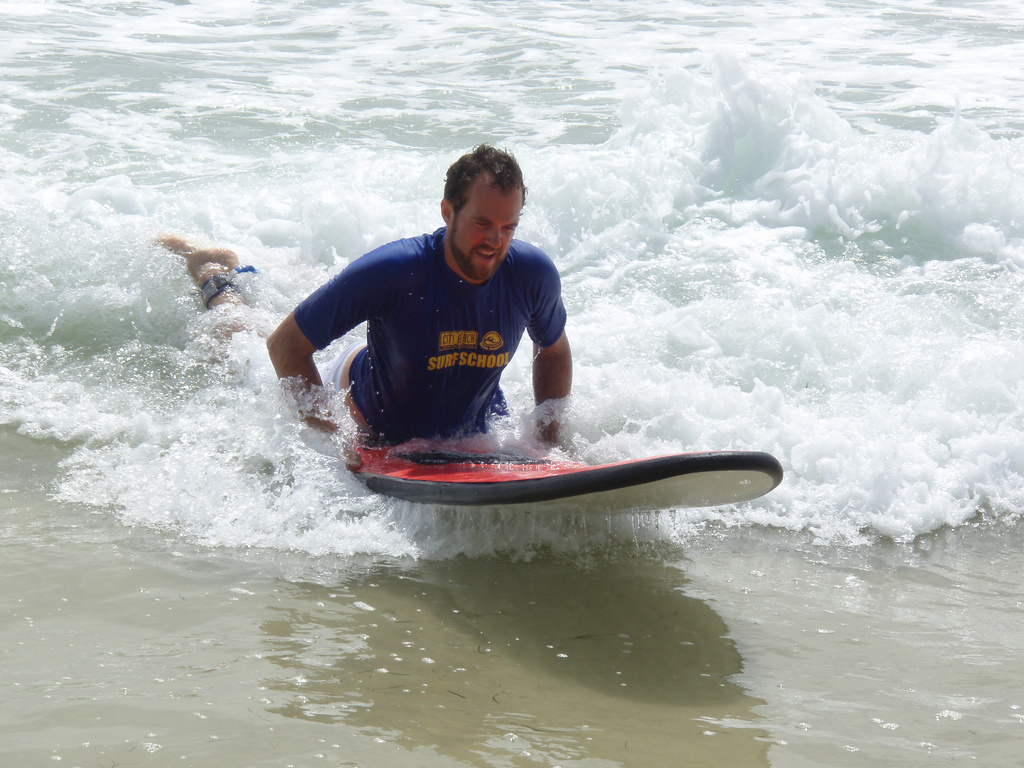
Popping up
First up it’s time to tackle the moderately difficult portion of your task: popping up. If you watch good surfers, their transition from paddling to standing is fluid and nearly instantaneous.
It’s this essential pop up that continuously eludes all beginner surfers. It’s also the action that separates surfing from other water sports, and it’s the most important aspect of actually catching a wave.
Do it right and you’re set for the initial drop and first turn or pump with feet in correct position, proper balance, and full confidence. Do it wrong and you’ll have blown the wave and been served an extra soggy slice of humble pie.
It seems so misleadingly simple when you observe from afar. But ask any surfer and they’ll tell you learning to stand up was the toughest part of catching their first wave. So how do you get good at it before your surfing holidays start? Simply practice.
You’ll need to try, try and try again before you master standing up. You won’t learn without failing a few times (‘few’ being an understatement). Before suiting up and hitting the water, lets consider technique and timing.

Beginner surfing tips: Technique
We’ve all seen the movie Point Break. Remember when Keanu Reeves needs to learn how to surf in order to fit in with the local surfing scene and infiltrate the bank-robbing crime ring? He befriends a surfer babe who takes pity on him and teaches him the basics right there on the beach.
As cheesy a flick as it is, her instructions are spot on. Popping up has little to do with the board, so forget it for a moment. The objective is to go from lying on your stomach to standing with your feet centred beneath you, knees bent athletically.
To use your body as a gauge, one foot should land just under where your sternum was, and the other foot just above where your knees previously were when lying down. You should arrive at this position in one fluid motion without kneeling or dragging your feet.
While I don’t advocate being as goofy as Keanu and practicing on the sand. One of the best of the beginner surfing tips is to try a few pop-ups in the comfort (and privacy) of your home.
Lay face down on the floor like you would a surfboard. Put one sock under the centre of your chest at the bottom of your rib cage and another just above your knees (honestly this will help you learn how to catch a wave!).
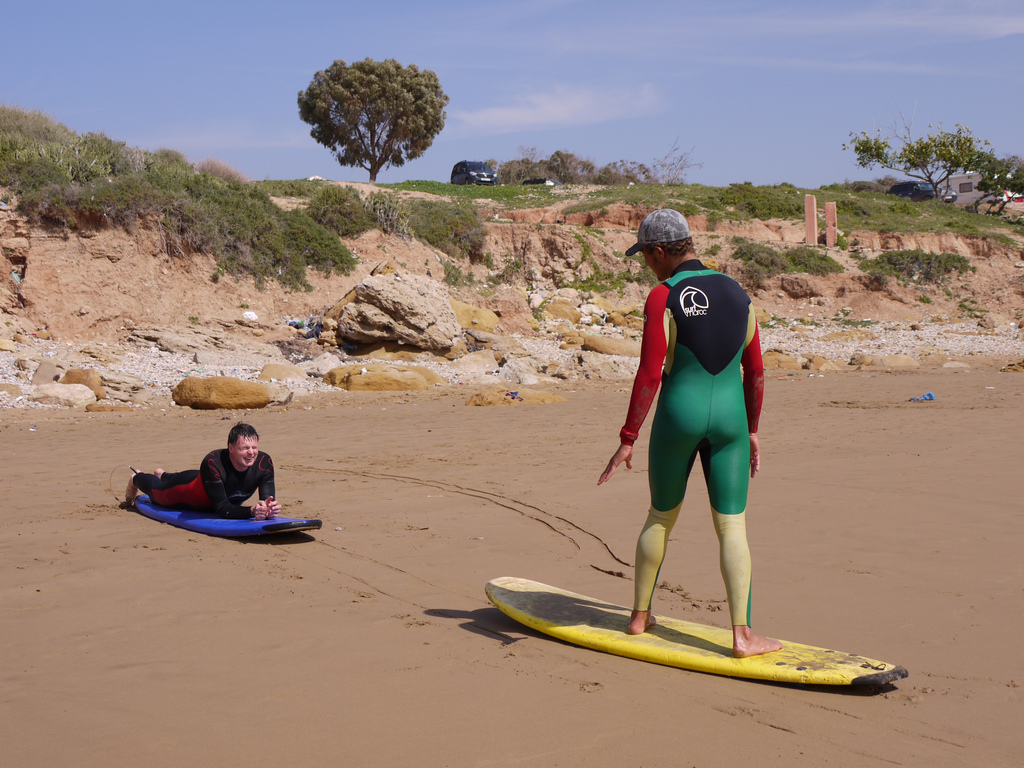
Imagine you’re paddling for your first wave. Then quickly pop up using your shoulders and arms to elevate your torso and your knees to bring your feet underneath your body.
Try to land your feet directly on the socks. Are you kicking them out of position while you pop up? You’re dragging your feet. Try again. The movement is a transition from push-up position to squat. Land on your strategically placed socks consistently, and you’ve nailed the technique.
How to catch a wave: Timing
Of course catching a wave is a bit more difficult than standing on your socks. Wave selection is a huge part of surfing and tough to explain.
For beginners, let’s stick to something small, or even something that has already broken and is now whitewash moving towards shore. As the wave is moving, so should you. Be evenly balanced on your board as you paddle.
You should not be falling off to either side or have the nose way up in the air or down under the surface. Continue to paddle as the wave hits your feet and the tail of the board.

Popping as soon as you sense the wave has arrived is a common mistake of beginners. Instead, the idea is to try and match the speed of your paddling with the speed of the wave before standing up.
This is difficult concept to understand because if you literally did paddle the same speed as the wave, your board and the wave would never meet. What really needs to happen is to paddle fast enough to allow the wave to begin to push you, not simply just wash over you.
The magical moment is when you feel that paddling is no longer the force propelling your board and instead the wave is pushing it. Now paddling should cease and the almighty pop up should be executed. With enough practice you will successfully surf your first wave.
If you enjoyed how to catch a wave you can find other beginner surfing tips here: https://adventuresportsholidays.com/surfing/beginner


