I was recently asked why use trekking poles? So in this guide to buying and using hiking poles, we’ll answer the ‘why?’, discuss the main features to look out for, and let you know how to use them.

Why use trekking poles?
The first time I saw people using poles to walk I was baffled. Why are they bothering? Walking sticks are for old people, right? Wrong. Very wrong.
According to the British Mountaineering Council (BMC), using walking poles shifts a fifth of your body weight to your upper body from other joints – per step!
Now multiply that by the thousands of steps you take… And you can quickly see how they will help offset the impact felt in your knees, hips, ankles and reduce leg muscle fatigue.
Trekking poles are also an excellent way to spread your weight as you have four points of contact. This helps you stay balanced on uneven terrain.
Using poles helps you to hike more quickly – or less slowly in my case! You’ll also burn more calories by engaging your upper body for an all over workout.
If you use trekking poles a lot you’ll build muscle on your arms, shoulders, neck and around your spine. Hiking poles are also known to improve your posture helping you avoid injuries.
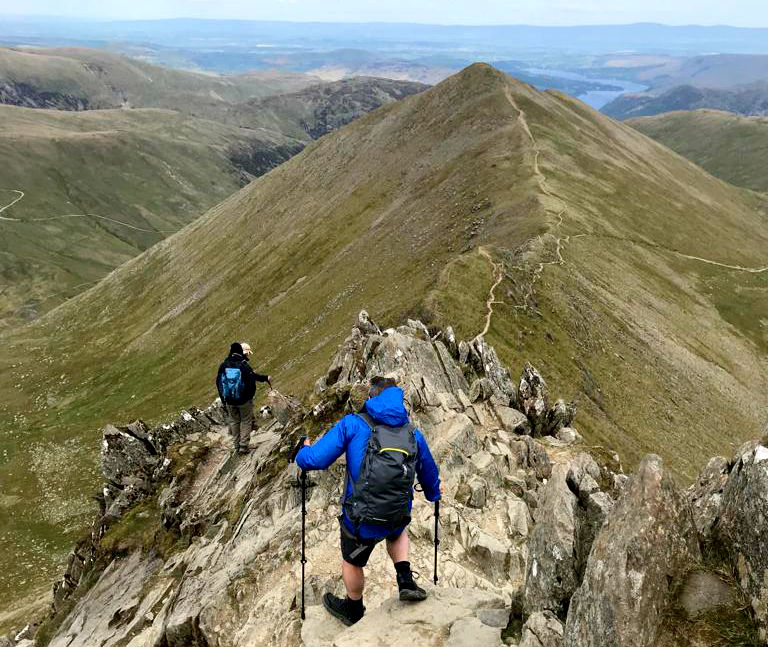
After a few knee problems I have used hiking poles in recent years. So for me, the answer to ‘Why use trekking poles?’ is that they save my knees on tough descents. Recently, when hiking in the Lake District I only used them on the downhill, but in the Alps I have also used them while ascending.
Guide to buying hiking poles
Here are the features you should look out for when you buy trekking poles:
Materials
This is where you need to decide your budget. As always, quality materials cost more, but with them should come increased performance, longevity, strength and reduced weight.
Top-end poles are likely to be made from carbon, cheaper models from aluminium. Having said that I have found the low cost Montem hiking products to be very good quality.

Anti shock/ Suspension
Suspension is available on some walking poles, usually as a spring in the handle that reduced impact. Even some cheaper models make use of internal springs and dampeners.
If you like the sound of this feature, look for models that let you lock out the suspension as you won’t want it in technical sections.
Straps
All poles should have a strap. Loop this over your hand and around the back of your wrist. When buying hiking poles look for straps that will be comfortable.
Grips
Cheaper models use hard plastic. Keep an eye out for quality foams and even cork.
Adjustable
All walking poles need to be height adjustable. The most common way they do this is with a twist lock that releases the telescopic tube.

Look for TUV certified models or similar benchmarks. There are some innovative locking mechanisms out there that offer stronger joints and quicker adjustments.
Varieties
Some poles are devised to telescope as small as possible. Other will only ever live in your hand or on the outside of your rucksack. So consider how you intend to use and carry them.
Baskets
Baskets are the rings at the bottom of your walking poles. Trekking above the snow line, you should choose wide baskets to help prevent the pole from plunging too deeply into snow.
Tips
Tips can be rubberised for use on concrete which gives more grip and makes less noise. Most are tipped with hard wearing metal for longevity and use on natural terrain.
Guide to using hiking poles
So we’ve answered ‘Why use trekking poles?’ and talked about features to look out for when buying hiking poles. Now you need to know how to use them. Firstly, introduce them slowly as many people get a tired upper body from use. Then gradually increase the distance and duration.

To be honest it is very similar to walking without poles with little technique to learn. Let your arms lead the way and plant the poles a little ahead of you with each alternate step.
For going down hill adjust the height and plant the poles further ahead. When stepping down use them to help support your weight a little, so each step impacts your knees and other joints a little less.
If you are climbing the poles need to be shorter. Push off them to help you ascend more quickly. Also in technical sections use them to help you balance and keep your footing.
Overall walk in a relaxed fashion. Just be aware of your posture and pole use. Don’t take bigger steps than usual, just keep it neat, relaxed and flowing.
Other considerations to use trekking poles
Our advice is to trust in known brands and take your own poles on a trekking holiday as quality varies. Trusting your weight on a substandard pole while descending with a heavy rucksack is not wise.

Decide which role your pole will take. Is it for weekend walking or for an expedition? Do you really need the very best on the market, or will a little looking around help you find a better, more reasonably priced model?
And test them out. Any retailer worth their salt will let you have a go. And for this reason buying hiking poles is best done in-store. Don’t blindly order online, as you’ll have no idea how it feels in-hand. Which, after all, is where a pole will spend most of its time.
We hope you found this guide to buying and using hiking poles useful. Next step check out our trekking holiday discounts as you could save a fortune on your next hike.