

Have you ever gotten off at the wrong bus stop? Probably. But did you turn around and blame the bus driver for your mistake? Probably not. As a skydiver, however, you’ve probably done exactly that – by exiting the plane at an inappropriate time, then accusing the pilot of ‘giving you a bad spot’. If you leap blindly out the door at the flash of a green light, it’s not the pilot who’s making the mistake – it’s you. Fix it with this quick skydive spotting tutorial.
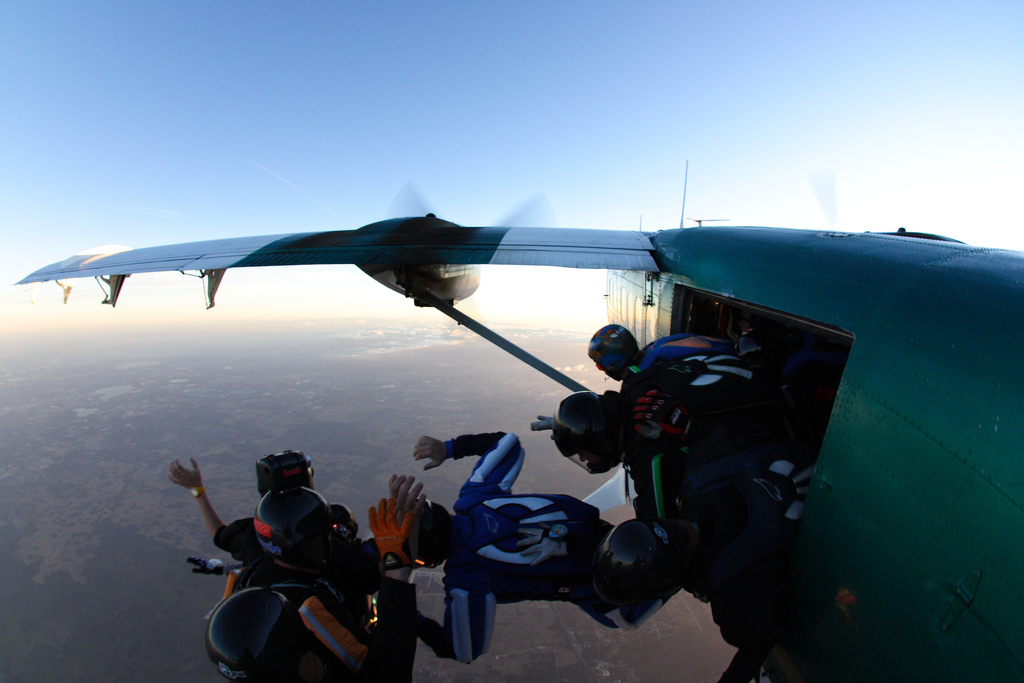
Five point skydive spotting tutorial
1. Understand the green light
The green light doesn’t necessarily mean that the pilot thinks you should leave the plane. This may be a suprise, but skydive spotting is actually not the pilot’s responsibility at all. The green light’s technical meaning is that he or she has completed all of the responsibilities of a jump pilot: that the necessary adjustments have been made to speed and trim to allow for safe exit, and that air traffic control has been informed that skydivers are preparing to leave the aircraft. It is the jumpers’ responsibility to verify a safe exit point.
2. Don’t rely on technology
The presence of a GPS system on nearly every skydiving aircraft has changed the game, of course. In many ways, it has allowed the skydive spotting process to slip quietly out of most jumpers’ minds and into the cockpit. Spotting used to be a purely manual process, and doublechecking the spot still must be.
3. Know your jump run
Most pilots fly skydiving jump runs into the wind, on a heading determined by GPS. From there, you’ll need to do some math to calculate your spot. Estimate your freefall and canopy drift using an online spot calculator or simply by running the calculations by hand. To do so, you’ll need to know the winds aloft, as well as the forecasted wind speeds and directions.
Online skydive spotting tools such as Skydive Academy Virtual Spot overlay the calculated spot on a Google satellite map. Making it much easier to visualize what the correct spot looks like when your head is hanging out the door of a plane.

4. Get your load in order
After you’ve run the numbers, boss-level spotting requires good communication with the rest of the skydivers on your load. These days, loads are packed with different disciplines, all with different glides and fall rates: slow-falling, long-gliding groups of wingsuits and fast-falling, short-gliding groups of head-down freeflyers share planes with high-altitude hop-and-pop canopy relative work jumpers and hybrid formations of every stripe.
The trick to remember is that, since the upper winds push freefalling jumpers across the sky, jumpers who will be exposed to them the longest will be pushed farther away from the landing area. If the safety officer on your drop zone (or the jumpmaster on the load) has not established a different rubric, the general rule is that belly formation skydivers exit first, then freefly groups, then students, then tandems, then trackers and wingsuits. The latter, because trackers and wingsuits cover significant horizontal distance and open higher.

5. Prioritize
If you’re the last one out and can only take a quick peek before you bail, prioritize. Look straight down from the door, checking for any air traffic and making a mental note of your direction of flight and of your exit point. Look to the landing area to make a general assessment that you’re within a landable distance of it. Even if you never calculate a spot, you’ll be a much safer skydiver for that five seconds’ worth of mindfulness – and you’ll make the skies safer for everyone else you share them with.
Hopefully this skydive spotting tutorial has been helpful and given you a guide as to what to do next time you’re about to exit a plane. Think about the five points above, make some quick calculations and use your head before you jump for the best and safest skydiving experience.




I had never thought about the complexity of jumping out of the plane in the right spot because I assumed GPS did all the work for us. Of course, people have been jumping since before GPS. Thank you for explaining the steps to spotting your jump correctly in order to keep the skies safe for the divers, as well as for other planes and air traffic. http://www.midwestfreefall.com/first-time/