

We were recently asked ‘what is windfoiling?’ So we turned to windsurfing guru Tez Plavenieks from Windsurfing UK Magazine for an answer. This is his experience of windsurf hydro foiling.

What is windfoiling?
A dangly piece of carbon (or aluminium/steel) thingy, with shark fin-esque wings, hanging off the back of your windsurfing board. Something that gets you hovering 3ft (ish) above the water in light to moderate wind strengths.
Yep, that pretty much answers ‘what is windfoiling’ in a nutshell. And it’s a topic that’s been gaining traction during the last few years – 2017 in particular.
Windsurf hydro foiling: Why?
As windsurfers we’ve all been searching for the Holy Grail of light air planing. You know, kit that gets you up and blasting in a kitten’s sneeze? Brands, to give them credit, did react and have been producing super efficient, but BIG/expensive, gear that does this very job.
Unfortunately price and technicalities of using such large equipment, not to mention the cumbersome nature of lugging and transporting it put the kybosh on light wind performance windsurfing for many.

Windfoiling, wind surf foiling or windsurf hydro foiling (whatever you want to call it) allows you to do away with those big rigs and make use of your standard size sails in the same wind strengths massive sails were once used.
If it’s 9.2m weather for conventional windsurfing then chances are you can get away with a 6m (minus the super high performance, wallet busting mast a 9.2m requires) and be flying almost immediately. Well, that’s the theory anyway.
My experience of windsurf hydro foiling
As part of the day job I test and review lots of watersports equipment, not just windsurf kit. Rewind to 2016 and I was first approached by AHD’s UK importer Kai Sports to try out some new foiling toys. With AHD being a brand into hydrofoiling from day dot, the French company was looking to take advantage of swelling interest in the discipline.
Upon landing AHD’s Shark foil ready board, complete with odd looking deck cut out, and AFS-1 foil looked lethal. I’d done a bit of genning up and among extremely limited details were quite a few comments about the consequences of it all going Pete Tong. This embedded anxiety and was probably why it took a while to actually get going (that and the weather not playing ball!).

AHD’s Bruno Andre – designer and chief tester of AHD foil gear – was a great source of inspiration. His vids and advice were enough to convince me of heading out, which I did on a blustery/chilly day when my normal freestyle kit would’ve worked perfectly well.
First take offs
Having connected all the bits and bobs I was ready for the off, if I could just get the damn thing to the water’s edge! Due to that long dangly thing carrying foil equipment is a royal pain in the arse, I kid you not. There are a variety of techniques, none of them particularly comfortable.
If you’re looking to windfoil then I highly recommend picking a location with a put in that’s close to your vehicle’s parking spot. Avoid hiking miles with foil in arm at your peril!
Huffing and puffing I finally made it to the brine’s edge. Next obstacle is getting enough depth to launch – that dangly thing has considerable draft. Once in deep water it’s then a case of clambering aboard and uphauling. All of the advice and guidance I received warned of waterstarting.

Firstly, if there’s enough wind to launch normally then there’s probably too much to learn to foil. Secondly, waterstarting means your tootsies are susceptible to slicing should they connect with the foil’s edges.
Up into sailing position and I immediately adopted the tried and tested dynamic hooked in/outboard/straight 7 stance that normally has riders planing and in the straps. Wrong move! Straight away a gust hit, the foil powered up, lifted quickly (too much!), I over foiled and took my first of many dunkings.
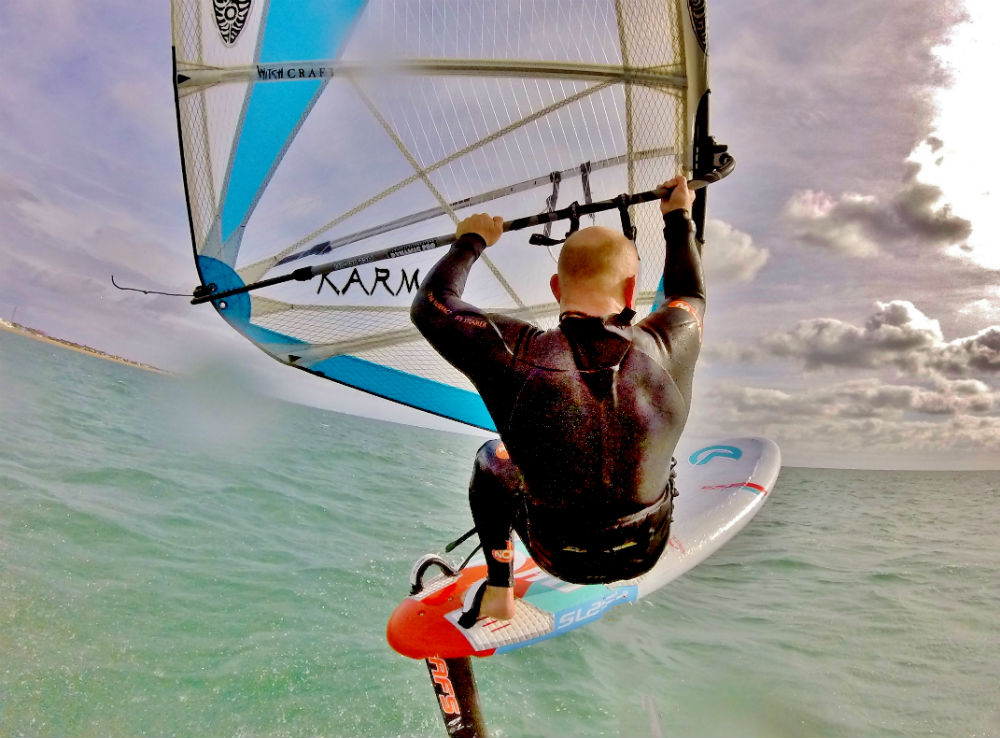
The thing to get your head around is foiling, of any kind, is all about controlling the nose and therefore the foil’s lift. For sure you want to get flying, but once in the air it’s a case of staying inboard with weight forwards.
As you become more experienced, foilers can play around with their stance, altering trajectory and points of sail. But for first goes you’re trying to find that sweet spot and enjoy sustained flights. Loading up the back foot and leaning outboard whilst hooked in is therefore not the best course of action.

Almost windsurf hydro foiling
It took a few more runs but ultimately I realised in that first session I was on too big a rig for the wind strength so it was back to the drawing board. What followed were a few more conversations with Jon Popkiss (Kai Sports owner) before I hit the salt once again.
This time the breeze was much lighter (around 10 knots) and I opted for a bigger rig (7.5m). Heading from the beach and so far so good. A bit of momentum and…nothing! No foiling, no flying, nada. After around half an hour I was getting frustrated so headed back to the beach to take stock.
What many people don’t realise is windfoiling in light winds is actually quite technical. Sub-15 knots requires a deft technique and a specific set of conditions to actually work efficiently. For instance chop can be a foiling killer.
When looking to fly your board needs momentum. Chop halts your progress and is a little like pushing water up hill, when sailing into lumps at least.
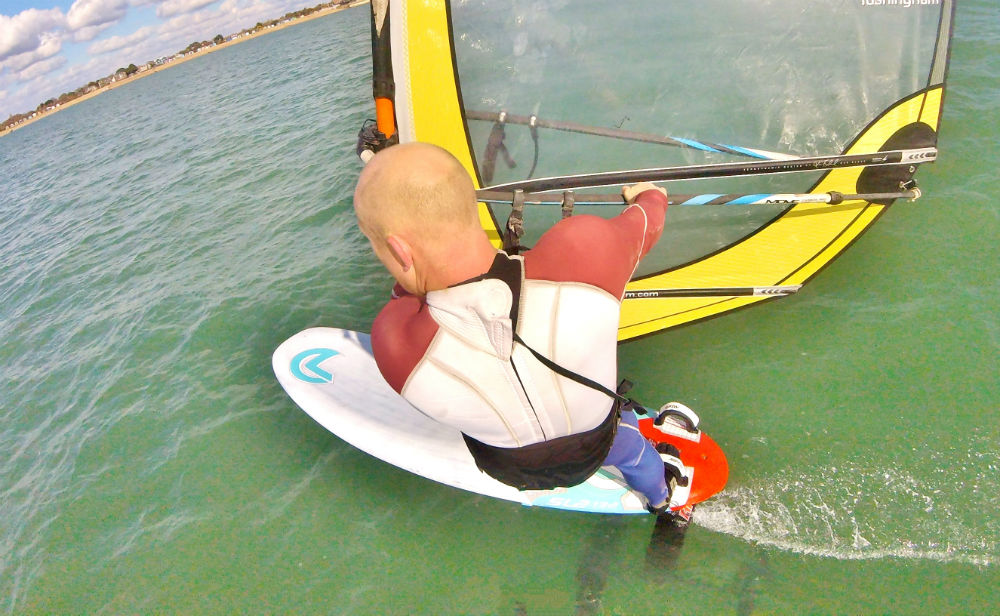
On the flip those peaks and troughs can help if you learn how to use them as downhill slopes. In this way they can help increase your speed. A flat water venue, however, is a good idea for learning those first foiling steps.
Finally, after a few more false starts, I hit the foiling jackpot and scored a low tide 12-15 knot steady wind session. (I should also add that gusty winds make windsurf hydro foiling tricky). Within the space of an hour I’d managed to get the board up and was starting to get the hang of it. By no means an expert, but getting the feeling of flying. Still with a few crashes but that’s not unusual.
Actually windfoiling
Following on from my experiences with the Shark I was then passed AHD’s Sealion Wings strapless 7’6 multi-discipline board. WindSUP, SUP surf, windfoil and SUP foil all in one nifty package. I stuck with the AFS-1 foil but found the uncluttered deck of the SL easier when searching for that foiling sweet spot.
Even though on paper the dimensions of the Sealion Wings 7’6 are smaller than the Shark I found it preferable – or maybe my skills were improving. Suffice to say the next few months were spent really getting to know the set up and hitting my piloting milestones.

There were some idyllic sessions I enjoyed; flying above the water on sunny summer days is simply sublime. At this point in the season my local water is flatter with less swell. I soon started trying a few moves – gybes mainly – with degrees of success.
It soon became apparent, however, that it was time to switch gear. After all, in the time I’d been learning equipment had leapt on considerably. Swapping the SL and AFS-1 for AHD’s SL2 foil ready freerace board and AFS-2 was simply revelatory.
Having persevered with all the setbacks and ‘issues’ during the learning phase, this new gear was a world away in terms of performance. The bigger board did indeed give more leverage over the foil. It’s soft round rails made hard landings, should the board drop suddenly, easy to deal with and the AFS-2 foil was (and is) supremely controllable and smooth.
It’s a much easier design to put your faith in and concentrate on enjoying the ride rather than focusing on not crashing. And having tested a number of other foils since I can confirm the AFS-2 is one of the most well mannered windfoils on the market.
Future of windfoiling
As of March 2018 I’m working my way through a bunch of foiling test gear and having some interesting experiences. It’s a discipline that’s very much in its infancy and no doubt during the coming months will evolve further.
There’s definitely a void in terms of knowledge and skills/understanding with the sport, which is why I wanted to answer the question ‘what is windfoiling?’. But this understanding is now being addressed by some peeps.
Expense and the cost of kit is a concern for would be foilers, but some brands have already made progress with bringing prices down. It’s (at the time of writing) possible to get hold of a foil for less than £700. I’m sure that’ll drop further as we move forwards, as well as second hand gear becoming readily available.
Windsurf hydro foiling won’t be for everyone, that’s for sure. But it could plug a gap for certain windsurfers who are looking for new challenges and a way to utilise light airs more efficiently – inland sailors particularly might find favour with windsurf hydro foiling.

My own flying has improved no end. I’m now comfortable jumping on the foil and going round corners. As a comparison I tell people when asked that it’s easier to learn how to fly than it is learning to plane in the footstraps.
From an industry standpoint the high end aspect of windfoiling is being pushed. I hope this doesn’t end up going over the top. Making foiling too technical and all about performance is exactly what happened to standard windsurfing back in the 90s.
It’s why some sacked windsurfing off to pursue other disciplines like kitesurfing. Foiling as it stands, for the recreational sailor at least, should simply be about ‘mowing the lawn’ backwards and forwards with the odd turn chucked in, just like freeriding is.
This may sound dull, and indeed look like dishwater, but for the person flying it certainly isn’t boring. If you’re a competitive type who wants to race then so be it, but the majority will simply be happy flying in the sun. It’ll be interesting to see where windfoiling goes – stay tuned.
Thanks to Tez Plavenieks editor of Windsurfing UK Magazine, SUP Mag UK and Sitons.com for answering the question ‘What is windfoiling’ and explaining his experiences trying the burgeoning sport of windsurf hydro foiling.


